

Robinhood Chain has quickly become one of the most closely watched new ecosystems in the crypto market. New users, fresh liquidity, tokenized real-world assets, memecoins and unusually high APRs have created the perfect conditions for attention to spread across the network.
Part of this renewed activity is also connected to improving sentiment in the broader crypto market. When Bitcoin rises and traders begin returning after a difficult period, emerging ecosystems tend to attract speculative capital. New networks can then experience rapid growth as users search for early opportunities.

Robinhood Chain has several elements that make it particularly interesting. It combines Robinhood’s established financial brand with permissionless blockchain infrastructure, tokenized stocks and decentralized finance applications.
However, attention and opportunity do not eliminate risk.
Users entering the ecosystem because of FOMO may encounter volatile memecoins, illiquid tokens, concentrated liquidity positions and APRs that look attractive but are difficult to sustain. Before allocating capital, it is essential to understand exactly what is being purchased and how each DeFi position behaves.
What Is Robinhood Chain?
Robinhood Chain is a permissionless, Ethereum-compatible Layer 2 network developed to connect crypto, traditional financial markets and tokenized real-world assets.
Because it is EVM-compatible, applications and wallets built around Ethereum standards can integrate with the network. Robinhood Wallet supports the chain natively, while other compatible wallets can connect using its RPC information.
The network uses ETH to pay transaction fees. Therefore, users interacting directly with decentralized applications on Robinhood Chain should maintain enough ETH in their wallets to cover gas.
Robinhood Chain operates independently from users’ regular Robinhood brokerage and crypto accounts. Holding assets in the Robinhood app is not the same as managing tokens through a self-custodial wallet on Robinhood Chain.
This distinction becomes particularly important when interacting with unfamiliar protocols. In a self-custodial environment, the user is responsible for wallet security, transaction approvals and verifying contract addresses.
Why Tokenized Stocks Are Attracting Attention
One of Robinhood Chain’s strongest narratives is access to tokenized real-world assets.
Through compatible applications, eligible users can obtain exposure to tokenized versions of assets connected to companies such as Apple, NVIDIA and Alphabet. Private companies such as SpaceX have also appeared among the tokenized assets available through supported platforms.
Uniswap has integrated Robinhood Stock Tokens into its web application, wallet and infrastructure. This allows eligible users to discover and trade these assets using an experience similar to a regular token swap.
For crypto users, this creates an interesting bridge between DeFi and traditional markets. Instead of moving money through multiple platforms and settlement systems, users can access different types of financial exposure from an onchain wallet.
Nevertheless, buying a Stock Token should not be confused with directly buying a company’s shares through a traditional broker.
According to Robinhood’s official disclosures, its Stock Tokens are tokenized debt securities that provide economic exposure to an underlying security. They do not necessarily grant legal or beneficial ownership of the underlying shares.
This means a token linked to Apple, for example, may track the economic performance of Apple stock without providing the same shareholder rights as owning an Apple share through a brokerage account.
Access is also subject to geographic, regulatory and eligibility restrictions. Robinhood Stock Tokens are not available to US persons, and other jurisdictions may impose additional limitations. Some tokenized securities may also require KYC, allowlisting or issuer approval.
Tokenization makes access and settlement more flexible, but it does not remove legal, issuer or counterparty risks.
Uniswap and the Growth of Onchain Stock Liquidity
Uniswap v2, v3, v4 and UniswapX are available on Robinhood Chain, with Uniswap serving as an important public liquidity layer for the network.
This infrastructure allows users to swap tokens and provide liquidity to markets involving crypto assets, stablecoins and Stock Tokens. It also enables unusual markets that are difficult to reproduce in traditional finance.
For example, tokenized stocks can trade against other stocks, index products or stablecoins. According to Uniswap Labs, ten tokenized stocks paired against a tokenized version of the SPY index generated approximately $33 million in volume from more than 11,000 traders during their first 12 days.
This demonstrates genuine demand for onchain markets connected to traditional assets.
However, it also creates new risks for inexperienced liquidity providers.
Why High APR Does Not Mean Guaranteed Profit
Some Robinhood Chain liquidity pools display extremely high APRs. These percentages can attract users who assume that a larger APR automatically represents a better opportunity.
APR is not a guaranteed return.
A liquidity pool’s estimated APR may be based on recent trading volume, fees and the amount of liquidity currently deposited. If volume decreases or additional liquidity enters the pool, the projected return can decline quickly.
A pool may display an extraordinary APR because it is new, volatile or has very little liquidity. Those are often the same characteristics that make the position more dangerous.
Before entering a pool, users should examine:
- The two assets that form the pair.
- The pool’s total liquidity.
- Recent and sustained trading volume.
- The selected fee tier.
- The concentration of token ownership.
- The position’s minimum and maximum price.
- Whether they are comfortable holding either asset individually.
- Any issuer, smart contract or geographic restrictions.
If the only reason for entering a position is the displayed APR, the user probably has not evaluated enough of its risks.
What Happens When a Liquidity Position Leaves Its Range?
Uniswap v3 and v4 allow liquidity providers to concentrate their capital within a selected price range. Concentrated liquidity can generate more fees while the market price remains inside that range, but it requires more active management.

When the price moves outside the selected range, the position becomes inactive and stops earning trading fees. Depending on which direction the price moved, the liquidity can also become entirely concentrated in one of the two assets.
Consider a simplified SpaceX Stock Token and USDG pool.
A user may enter the pool because it displays an attractive APR. If the price changes significantly and leaves the selected range, the position could eventually become almost entirely composed of the SpaceX-linked token.
The user has not technically been liquidated, and the liquidity position is not automatically locked. However, the user may now have far more exposure to the tokenized asset than originally intended.
If the asset declines, the value of the position may fall. If the user withdraws and then attempts to convert the token back into a stablecoin, limited market liquidity can create an additional problem.
According to Uniswap’s explanation of price impact, trades executed against pools with lower liquidity can cause larger price movements and potentially worse outcomes.
Therefore, users should distinguish between three separate risks:
- The liquidity position moving outside its active range.
- The position becoming concentrated in one asset.
- The cost of selling that asset in a market with limited liquidity.
A high APR may not compensate for these losses.
Impermanent Loss Still Matters
Liquidity providers must also consider impermanent loss.
This occurs when the prices of the deposited assets change relative to the moment they were added to the pool. As trades alter the balance between the assets, the final value of the liquidity position may become lower than simply holding the tokens separately.
The term “impermanent” can be misleading. If liquidity is removed while the difference exists, the loss becomes realized.
Concentrated liquidity can increase capital efficiency, but it can also increase exposure to impermanent loss. Narrower ranges require more precise management and can move out of range much faster during volatile conditions.
Pairs containing a stablecoin and a volatile Stock Token or memecoin can be especially difficult for beginners. If the speculative asset falls sharply, the position can accumulate more of the declining asset while reducing the stablecoin balance.
The fees generated by the pool must be compared against this change in the value and composition of the position.
The Memecoin Boom on Robinhood Chain
Robinhood Chain has also developed a rapidly expanding memecoin market.
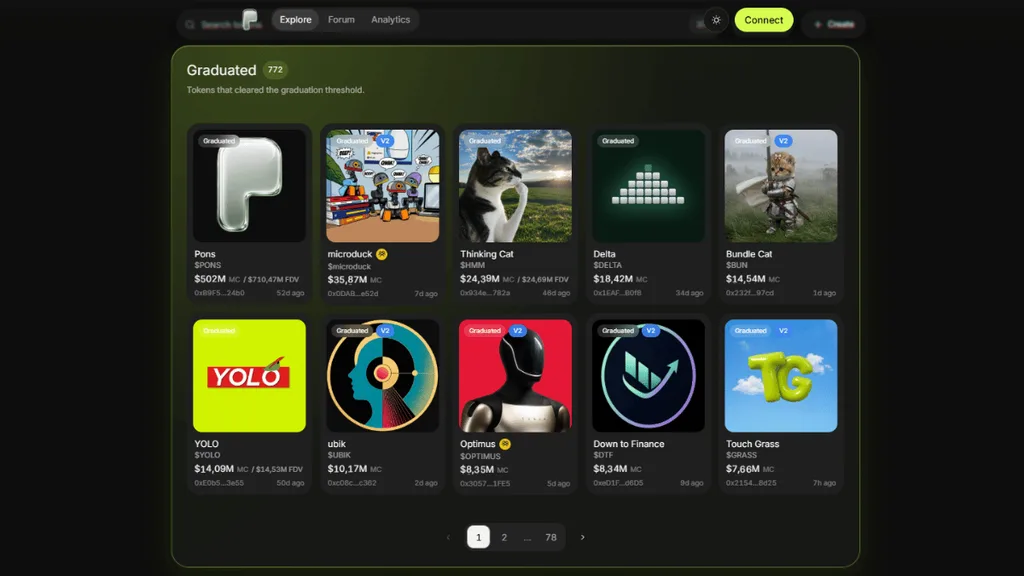
Platforms such as Pons have attracted attention by creating an experience similar to the token-launch model popularized by Pump.fun on Solana. Users can discover and trade newly created tokens, while the ecosystem benefits from rapid speculation and social activity.
Pons and the PONS token should not be confused with Robinhood itself. Pons is a third-party protocol built on Robinhood Chain, while PONS is a speculative token associated with that ecosystem.
Comparisons between Pons and Pump.fun have focused on activity, trading fees and the speed at which new tokens are being created. However, short-term fee rankings can change quickly and should not be interpreted as proof of sustainable adoption.
The popularity of a launchpad does not make every asset launched through it legitimate or valuable.
Permissionless token creation means almost anyone can deploy a memecoin. Some creators may remain anonymous, token ownership may be highly concentrated and liquidity can disappear rapidly. Even when a project does not execute a traditional rug pull, early wallets may sell into later buyers and cause the price to collapse.
A memecoin can reach a significant market capitalization through attention alone. It can also lose most of that value when traders move to the next narrative.
Is Buying PONS After a Large Rally Worth the Risk?
PONS has become one of the most recognizable speculative assets connected to the Robinhood Chain memecoin narrative.
Its connection to an active launchpad gives traders more metrics to monitor than a completely utility-free memecoin. These may include platform volume, fees, token launches, liquidity and continued user activity.
Even so, PONS remains a highly speculative asset.
After a rapid price increase, new buyers must consider whether they are entering because of a sustainable thesis or because previous holders are publishing large profits. The higher the valuation becomes, the more capital may be required to continue producing similar percentage gains.
The rally could continue if Robinhood Chain attracts more users and Pons maintains its relevance. It could also reverse sharply if launchpad activity declines, competitors gain market share or the broader memecoin market loses attention.
Anyone choosing to speculate should use a position size that reflects the possibility of a substantial or complete loss. A small speculative allocation is fundamentally different from treating the token as a low-risk investment.
A Robinhood Chain Airdrop Has Not Been Confirmed
There is currently no official confirmation that Robinhood Chain will distribute a token through an airdrop.
The absence of an announcement does not prove that an airdrop will never happen, but users should not interact with protocols or expose capital solely because influencers are speculating about one.
Robinhood operates within a complex regulatory environment, and its chain already uses ETH for gas. Any suggestion that normal network activity guarantees eligibility for a future token should be treated as speculation unless Robinhood publishes official criteria.
Users exploring new ecosystems can use RR Manager to keep research and potential opportunities organized, but every campaign should still be confirmed through official project channels.
How to Avoid FOMO on Robinhood Chain
Before trading or providing liquidity, users should follow a basic risk-management process.
First, research every asset in the pair. If you would not be comfortable holding one of the tokens independently, you should reconsider providing liquidity to that pair.
Second, verify the contract address. Memecoin and emerging-chain activity frequently attracts fake tokens using names and symbols copied from popular projects.
Third, examine liquidity and price impact before entering. Being able to purchase a token does not guarantee that a large position can later be sold at a reasonable price.
Fourth, understand the liquidity range. A narrow position may display impressive projected returns while requiring constant monitoring.
Fifth, avoid relying exclusively on screenshots of profits or APRs. These numbers rarely show impermanent loss, transaction costs, realized losses or the amount of time spent actively managing the strategy.
Finally, define the maximum amount you are prepared to lose before entering a speculative position.
The Opportunity Is Real, but So Are the Risks
Robinhood Chain presents a compelling combination of DeFi infrastructure, Stock Tokens and permissionless markets. Its ability to bring tokenized financial exposure onchain could become far more significant than the current memecoin cycle.
At the same time, early ecosystems often mix genuine innovation with aggressive speculation.
High APRs can disappear. Liquidity positions can become single-sided. Stock Tokens do not necessarily provide direct ownership of company shares. Memecoins can collapse when attention moves elsewhere, and no Robinhood Chain airdrop has been officially confirmed.
Experienced traders who understand liquidity management and follow the ecosystem closely may find interesting opportunities. New users should move more carefully, study each position and avoid committing capital simply because others appear to be making money.
Robinhood Chain may have long-term potential, but surviving the hype requires understanding what can go wrong before chasing what could go right.
