
Apyx is an innovative DeFi protocol that introduces a new model for stablecoin yield generation. It positions itself as the first Dividend-Backed Stablecoin (DBS) protocol, designed to transform dividend streams from traditional public market assets into programmable on-chain yield.

Instead of relying on conventional stablecoin reserve models or opaque yield strategies, Apyx connects real-world dividend income with blockchain-based stable assets. Its goal is to create a more transparent and sustainable alternative for users who want stablecoin exposure while also earning real yield.
At its core, Apyx turns dividends generated by preferred shares from Digital Asset Treasuries (DATs) into on-chain income. This allows the protocol to offer yield through real-world assets (RWAs), while maintaining transparency, over-collateralization and practical utility across DeFi.
Unlike traditional stablecoins such as USDT or USDC, which are mainly designed to preserve dollar value, Apyx aims to create a yield-bearing stablecoin ecosystem where users can access stable digital dollars backed by recurring dividend flows.
What Makes Apyx Different?
The main innovation behind Apyx is the concept of a Dividend-Backed Stablecoin.
Most stablecoins rely on fiat reserves, treasury bills, cash equivalents or lending strategies. Apyx follows a different path by using preferred shares from public market companies and Digital Asset Treasuries that generate consistent monthly dividends.
These dividends are then converted into yield and distributed on-chain.
This model creates a stablecoin system designed to solve one of the biggest limitations of traditional dollar assets: inflation erodes purchasing power over time. By offering a stablecoin that can generate double-digit yield from real-world dividend income, Apyx introduces a new savings layer for DeFi users.
The protocol focuses on transparency, sustainability and low volatility by using regulated, publicly visible assets rather than purely crypto-native incentives.
How the Apyx Protocol Works
Apyx connects traditional financial markets with blockchain infrastructure through a structured off-chain and on-chain flow.
The process begins when users deposit capital into the protocol. That capital is then used to acquire dividend-generating backing assets. The dividends are collected off-chain, converted into protocol yield and distributed on-chain to users who hold yield-bearing assets.
The protocol provides daily NAV (Net Asset Value) dashboards, giving users visibility into the composition of reserves and the performance of the backing assets.
This structure is designed to provide:
- Stability
- Real yield
- Transparency
- Liquidity
- Verifiable reserve management
Apyx essentially acts as a bridge between public market income and programmable DeFi yield.
The Four Core Components of Apyx
Apyx operates through four interconnected components.
1. Users
Users deposit USDC into the protocol to mint or acquire apxUSD, the main stable asset in the Apyx ecosystem. They can then decide whether to simply hold apxUSD or lock it into the yield vault to receive apyUSD.
2. Off-Chain Treasury
The off-chain treasury allocates capital into a diversified basket of preferred shares and liquid cash equivalents. These assets are selected to generate recurring dividend income while maintaining relatively low volatility.
3. On-Chain Vault
The on-chain vault receives yield generated from dividends and distributes it to holders of apyUSD. Over time, this increases the redemption value of apyUSD.
4. External Public Markets
The underlying assets come from traditional financial markets. They are held securely through custody structures and are supported by third-party reporting to verify reserve integrity.
Together, these components allow Apyx to connect regulated yield sources with DeFi-native assets.
The Dual Token Model: apxUSD and apyUSD
One of the most important features of Apyx is its dual-token structure.

This model separates liquidity from yield, giving users more flexibility depending on their strategy.
apxUSD: The Stable Asset
apxUSD is the primary synthetic stable asset of the protocol.
It is designed for:
- Liquidity
- Trading
- Collateral use
- DeFi and CeFi integration
apxUSD does not generate yield directly. Its purpose is to remain liquid and useful across secondary markets.
The asset is over-collateralized by protocol reserves, meaning reserves are designed to remain above 100% of the outstanding supply.
apyUSD: The Yield-Bearing Version
apyUSD is the yield-bearing wrapper of apxUSD.
Users obtain apyUSD by locking apxUSD into the on-chain vault. This process includes a 20-day unlock period.
apyUSD accumulates yield from dividend income distributed by the protocol. This makes it more suitable for:
- Long-term holders
- Stablecoin yield strategies
- DeFi looping strategies
- Users seeking passive income
Over time, the redemption value of apyUSD increases as yield is distributed through the system.
How Yield Is Generated and Distributed
Apyx yield comes directly from dividends paid by preferred shares held by the protocol treasury.
The process works like this:
- The protocol collects dividends from backing assets
- Dividends are converted into apxUSD
- Yield is sent to the on-chain vault
- The redemption value of apyUSD increases gradually
The distribution happens over a 20-day period, creating a smoother compounding mechanism.
The APY is calculated based on the 30-day average of annualized dividends. According to the article base, apyUSD currently offers yield in the range of 12% to 13% annually, which is significantly higher than many traditional stablecoin lending markets.
Another important point is that Apyx avoids rehypothecation. The protocol does not lend out user deposits or recycle them through opaque leverage structures. This helps preserve reserve integrity and reduce systemic risk.
Governance and the APYX Token
Apyx plans to introduce decentralized governance through the APYX token.
The APYX token is expected to give holders influence over key protocol decisions, including:
- Treasury strategy
- Protocol development
- Reserve management
- Ecosystem growth
- Incentive design
APYX holders may also receive a portion of monthly reserve growth, aligning incentives between the community and the protocol.
The project is supported by DeFi Development Corp., listed on Nasdaq as DFDV. This connection brings institutional expertise, regulatory awareness and alignment with public market shareholders.
Transparency, Risk Management and Advantages
Apyx places strong emphasis on transparency and risk control.
The main advantages include:
- Daily NAV visibility
- Real-time reserve reporting
- Over-collateralization
- Third-party reserve verification
- Automatic collateral rebalancing
- Exposure to regulated public market assets
The protocol also uses stress testing and low-cost hedging mechanisms to reduce risks linked to dividend rate changes, market volatility or drawdowns in Digital Asset Treasury assets.
Apyx is available on networks such as Ethereum and Base, with Solana expected in the future. This gives the protocol broader DeFi compatibility and makes it easier for users to integrate apxUSD and apyUSD into different strategies.
However, users should be aware of certain limitations. The protocol may not be available to residents of the United States, the European Union or sanctioned jurisdictions. Redemptions are settled in USDC, which also introduces some counterparty and stablecoin dependency risk.
Why Apyx Matters in DeFi
Apyx is not just another yield protocol. It introduces a different model for connecting real-world dividend income with on-chain stable assets.
By combining:
- RWAs
- Stablecoins
- Dividend income
- DeFi composability
- Institutional-grade reserve management
Apyx creates a new category of yield-bearing digital dollars.
For users seeking real yield without relying entirely on crypto-native emissions, Apyx offers an interesting alternative. It brings traditional income streams into DeFi while preserving the programmability and flexibility of blockchain-based assets.
How to Farm the Apyx Airdrop
Apyx has an official points program called Pips, launched on February 27, 2026.
The purpose of the program is to reward users who deploy capital within the Apyx ecosystem. These points are directly convertible into $APYX tokens at the Token Generation Event (TGE).
The team has publicly confirmed that the airdrop will be distributed based on accumulated Pips, and the TGE is scheduled for October 13, 2026.
On that date, Pips from previous seasons are expected to become claimable.
Apyx Seasons and Token Allocation
The Apyx points program is divided into seasons.
Season 1
Season 1 ended on May 22, 2026.
It allocated 5% of the total APYX supply to participants. Since the total supply is fixed at 100 million APYX, this represents 5 million APYX for Season 1 users.
Pip balances were finalized on that date and will count toward the future airdrop.
Season 2
Season 2 started immediately after, on May 23, 2026.
This season increased the allocation to 6% of the total supply, representing 6 million APYX.
Together, Season 1 and Season 2 reserve 11% of the total supply for early users, which is a very significant allocation for a DeFi protocol.
How to Farm Apyx During Season 2
Since Season 2 is currently active in the article’s context, the main goal is to accumulate as many Pips as possible before the season ends.
Below is the basic farming process.
Step 1: Access the Official Apyx App
Visit the official Apyx app and connect your wallet.
Make sure you are using the correct official platform and avoid fake links, especially because airdrop campaigns often attract phishing attempts.
Step 2: Swap USDC for apxUSD
Go to the Swap section.
Swap USDC or another supported asset into apxUSD, the main stablecoin of the protocol.
apxUSD is the base asset used to participate in Apyx yield strategies and earn Pips.
Step 3: Choose a Multiplier Strategy
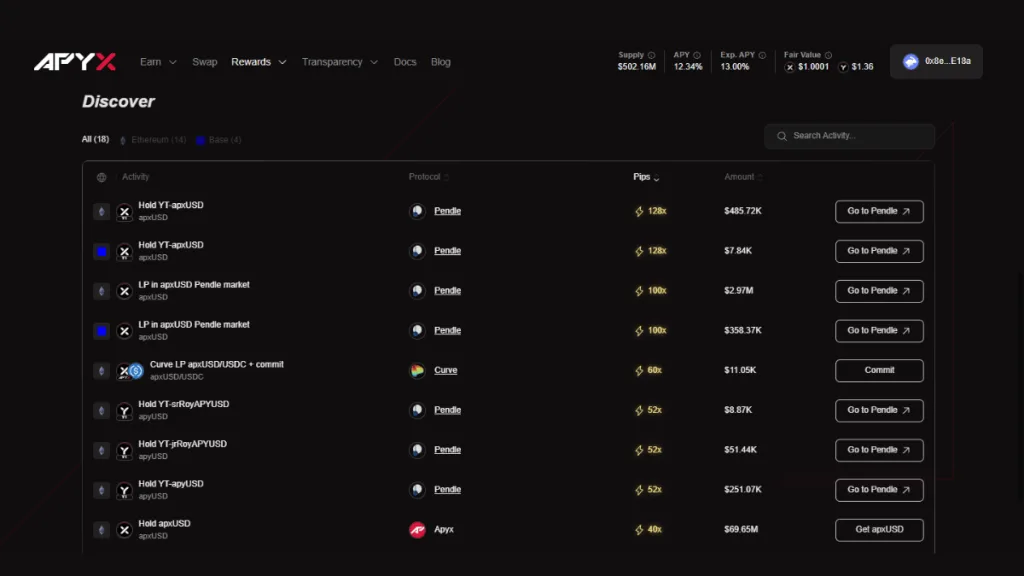
In the Rewards section, Apyx shows different ways to earn Pips using apxUSD.
Each strategy has its own multiplier.
The simplest strategy is simply holding apxUSD, which already provides a 40x Pips multiplier.
However, users looking to maximize points may consider more advanced strategies through partner protocols.
Pendle Strategy: High Multiplier Farming
One of the most attractive strategies mentioned in the article is using Pendle.

Pendle offers some of the highest multipliers for apxUSD-based farming, with two main options:
- LP strategies
- YT strategies
The strategy that generates the highest number of points is holding YT-apxUSD on Pendle.
This provides a 128x Pips multiplier, making it especially attractive for users with smaller capital who want to maximize point exposure.
Important Risk: YT-apxUSD Burns Principal Over Time
Although the YT-apxUSD strategy offers a very high multiplier, it comes with an important risk.
The YT token gradually loses value as it approaches maturity.
In this case, the YT-apxUSD maturity date is November 4. Until that date, the principal represented by the YT position is gradually consumed.
In exchange, users receive significantly higher point exposure.
This strategy can make sense for farmers focused on maximizing Pips, but users must understand that it is not the same as simply holding a stablecoin. There is a real cost involved.
Apyx is an interesting protocol because it combines real-world dividend income with DeFi yield strategies.
It is also easier to farm compared to many airdrop campaigns because the TGE date has already been announced. Having a known target date makes it easier to plan strategy, estimate opportunity cost and decide how much capital to allocate.
If the TGE happens as scheduled in October 2026, the launch may occur in a better market environment, potentially helping the token achieve stronger valuation.
However, risks remain.
Apyx is still a small protocol, and like any DeFi project, it carries smart contract, market, liquidity and protocol risks. Users should always study carefully and never risk more than they can afford to lose.
Disclaimer
This is not financial advice. If you decide to interact with the mentioned protocols, you do so at your own risk. Airdrop Guild is not responsible for any potential losses resulting from participation. Always do your own research before engaging with blockchain-based projects.
